Police departments nationwide train their officers to assume that a member of the community is armed using the “characteristics of an armed person” (CAP) framework. This framework, composed of multiple characteristics that ostensibly allow police to determine whether a person is carrying a handgun, has become a pseudoscientific justification for stop-and-frisk.
The CAP framework is a form of proactive policing: patrolling to find potential crime and preempt or stop it rather than responding to crime after it is reported. Such tactics lead to a myriad of legal and social problems, including racialized harassment, widespread distrust of police, and pervasive Fourth Amendment violations.
This Article examines the CAP framework, using the Baltimore Police Department’s (BPD) implementation of this framework as a case study. The BPD’s CAP training is so superficial and broad that nearly everyone exhibits the targeted characteristics. Everything from turning one’s body or touching one’s waistband to wearing an untucked shirt can give an officer cause to conclude a person might be armed. In effect, the CAP framework gives officers unbridled discretion to frisk whomever they choose and functions as a tool for racialized harassment.
This Article argues that the CAP framework cannot provide legal justification for stops and frisks, especially post-New York State Rifle & Pistol Ass’n v. Bruen. This Article likewise argues that use of the CAP framework as a proactive policing tactic violates the Fourth Amendment.
The full text of this Article can be found by clicking the PDF link to the left.
* Assistant Professor of Law and Director of the Criminal Defense Clinic, University of Denver Sturm College of Law. Former Assistant Public Defender in the Baltimore City Felony Division (Maryland Office of the Public Defender) from January 2022 to July 2024, and the Newark Felony Trial Division (New Jersey Office of the Public Defender) from September 2015 to January 2022. Thank you to Rebecca Aviel, John Bliss, Bernard Chao, Alan Chen, Ian Farrell, Tim Holbrook, Elizabeth Jordan, Sam Kamin, Nancy Leong, Justin Marceau, Viva Moffat, Seth Packrone, Govind Persad, Laurent Sacharoff, Wyatt Sassman, Sarah Schindler, Steffen Seitz, Michael Siebecker, Lisa Waters, Lindsey Webb, and the ABA-AALS Criminal Justice Roundtable for their incredible help developing this paper. Thank you also to the editors of the Columbia Law Review for their exemplary edits and thoughtful feedback.
Introduction
On May 11, 2023, a Baltimore Police Department (BPD) detective shot seventeen-year-old Mekhi Franklin in the back.
1
CBS Balt. Staff, Baltimore Police Release Body-Camera Video of Officer Shooting 17-Year-Old in Shipley Hill Neighborhood, CBS News, https://www.cbsnews.com/baltimore /news/baltimore-police-body-camera-shipley-hill-17-year-old-boy-shooting-officer/ [https://perma.cc/QSK8-RPLC] (last updated May 16, 2023); Lea Skene, Teen Shot by Baltimore Police Officer During Foot Chase, Hospitalized in Critical Condition, AP News (May 11, 2023), https://apnews.com/article/ baltimore-police-shooting-teen-critical-condition-39e57753d6efc0 e62aef1d69d0b81213 [https://perma.cc/2TRW-DDYA] [hereinafter Skene, Teen Shot by Baltimore Police Officer].
The encounter began when the detective approached Franklin and his friend.
2
Cadence Quaranta, Assault Charges Filed Against 17-Year-Old Shot by Police Officer in Shipley Hill, Balt. Banner (May 30, 2023), https://www.thebaltimorebanner.
com/community/criminal-justice/charges-17-year-old-police-officer-shipley-hill-PW5ODHB2KVHH3MHOJIIE2QS3HQ/ (on file with the Columbia Law Review).
Franklin and his friend tried walking away.
3
Id.
When the detective said, “Come here,” Franklin ran.
4
Id. (internal quotation marks omitted) (quoting Cedric Elleby, Detective, Balt. Police Dep’t).
The detective chased Franklin, later claiming to have seen Franklin pull something out of his waistband as Franklin ran, and then fired four shots at Franklin.
5
CBS Balt. Staff, supra note 1.
A bullet struck Franklin in the back as he continued to run away.
6
Id.
The detective who shot Franklin was a member of one of the BPD’s District Action Team (DAT) squads,
7
Id.
units dedicated to proactively policing neighborhoods that the BPD considers “high crime,” looking to identify and preempt criminal activity.
8
Brandon Soderberg, After the Gun Trace Task Force Scandal, BPD Established New Plainclothes Units. Are They More of the Same?, Balt. Mag. (May 2, 2023), https://www.baltimoremagazine.com /section/community/baltimore-police-department-plainclothes-district-action-team-units-gun-trace-task-force/ [https://perma.cc/7L6H-CXSS] [hereinafter Soderberg, After the Gun Trace Task Force Scandal] (internal quotation marks omitted).
The detective was not there investigating any offense, nor did he have any specific reason to suspect Franklin or his friend of doing anything unlawful.
9
Alex Mann, Cassidy Jensen & Darcy Costello, After Baltimore Police Shooting, Some Question: What Does ‘Displaying Characteristics of an Armed Person’ Really Mean?, Balt. Sun (May 12, 2023), https://www.baltimoresun.com/2023 /05/12/after-baltimore-police-shooting-some-question-what-does-displaying-characteristics-of-an-armed-person-really-mean/ (on file with the Columbia Law Review) [hereinafter Mann et al., After Baltimore Police Shooting].
After the shooting, the detective said that he engaged with and tried to stop Franklin because he believed Franklin exhibited “characteristics of an armed person.”
10
Id. (internal quotation marks omitted) (quoting Rich Worley, then-Deputy Commissioner, Balt. Police Dep’t).
Patrolling the community and looking for civilians exhibiting characteristics of someone who is armed is a form of proactive policing—a practice that this Article defines as police-initiated action aimed at reducing or preventing crime before it occurs.
11
Definitions of proactive policing differ. See, e.g., Nat’l Acads. of Scis., Eng’g, & Med., Proactive Policing: Effects on Crime and Communities 30 (David Weisburd & Malay K. Majmundar eds., 2018) (defining proactive policing as “all policing strategies that have as one of their goals the prevention or reduction of crime and disorder and that are not reactive in terms of focusing primarily on uncovering ongoing crime or on investigating or responding to crimes once they have occurred”).
While proactive policing is marketed as anticrime and pro-public safety, it in fact damages communities, hurts public safety,
12
See Lupe Victoria Aguirre & Simon McCormack, The Rise of Stop-and-Frisk Is a Dangerous Gift to the Trump Agenda, NYCLU (June 27, 2024), https://www.nyclu.org/commentary/ the-rise-of-stop-and-frisk-is-a-dangerous-gift-to-the-trump-agenda [https://perma.cc/54HK-LMYT] (“The heavy reliance on stop-and-frisk has never been an effective public safety tool. Though it’s been pitched as a way to prevent violent offenses, few guns are ever recovered and the vast majority of people who are stopped are completely innocent.”).
and encourages discriminatory policing and stop-and-frisks without sufficient cause.
13
See Rachel A. Harmon & Andrew Manns, Proactive Policing and the Legacy of Terry, 15 Ohio St. J. Crim. L. 49, 49 (2017) (“Proactive policing may make constitutional violations more likely because—when poorly implemented—it can encourage officers to engage in stops and frisks even when adequate suspicion is lacking or in a manner that discriminates.”).
People in proactively policed neighborhoods experience poorer health outcomes, including chronic stress and worse mental health.
14
See Juan Del Toro et al., The Criminogenic and Psychological Effects of Police Stops on Adolescent Black and Latino Boys, 116 Proc. Nat’l Acad. Scis. 8261, 8266–67 (2019) (finding that young people stopped by police more frequently engaged in more delinquent behaviors six, twelve, and eighteen months later, even when controlling for factors like past delinquency); Amanda Geller, Jeffrey Fagan, Tom Tyler & Bruce G. Link, Aggressive Policing and the Mental Health of Young Urban Men, 104 Am. J. Pub. Health 2321, 2324–25 (2014) (finding that police contact was a statistically significant predictor of PTSD in young men); Alyasah Ali Sewell, Kevin A. Jefferson & Hedwig Lee, Living Under Surveillance: Gender, Psychological Distress, and Stop-Question-and-Frisk Policing in New York City, 159 Soc. Sci. & Med. 1, 9–10 (2016) (identifying an association between escalated police encounters and psychological distress).
And, as it did after the BPD detective engaged Franklin, proactive policing can lead to police violence.
15
While Franklin survived being shot in the back by a BPD detective, others whom police have pursued based on the “characteristics of an armed person” (CAP) framework have lost their lives. The link between the CAP framework and police violence is discussed in depth in section II.D.
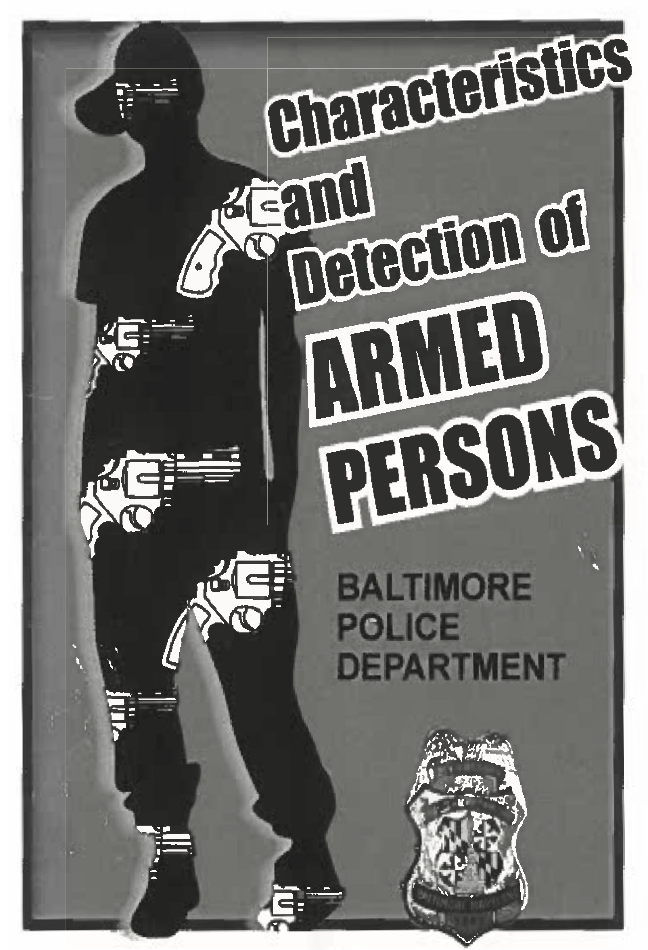
The BPD’s use of the “characteristics of an armed person” (CAP) framework is a form of proactive policing. Using standardized, written materials, the BPD trains its officers and detectives on the CAP framework. The BPD’s training materials include a slideshow and a pocket-sized thirty-nine-page booklet, the cover of which is shown below
16
Both the twenty-eight-slide slideshow, entitled Characteristics of Armed Persons, and the booklet, entitled Characteristics and Detection of Armed Persons, were already in this author’s possession. During this project, this author requested these training materials directly from the BPD pursuant to the Maryland Public Information Act but received only the Characteristics of Armed Persons slideshow (provided November 25, 2024) and not the booklet. See Balt. Police Dep’t, Characteristics of an Armed Person (Mar. 18, 2019) (unpublished slideshow) (on file with the Columbia Law Review) [hereinafter BPD Slideshow]; Balt. Police Dep’t, Characteristics of an Armed Person (n.d.) (unpublished booklet) (on file with the Columbia Law Review) [hereinafter BPD Booklet]. This training is discussed in more detail in section II.B.
:
Figure 1. BPD Booklet Cover
As the booklet cover attempts to illustrate, the CAP framework is all about finding concealed guns. The framework consists of a list of traits that purportedly indicate that a person may be armed. This includes someone who wears seasonally inappropriate clothing, a tailored shirt untucked, an outfit with something that does not match (like suit pants with a windbreaker), only one glove, or a fanny pack or an unzipped shoulder bag. It also includes someone who turns their body, touches their waistband, or wears or uses a shoulder bag but keeps their wallet in their pocket.
17
See infra notes 162–166 and accompanying text.
The list goes on, and, by its end, the CAP framework provides reason for police to stop practically anyone.
18
The unreliability of the CAP training will be discussed in section II.B. See infra notes 162–166 and accompanying text.
This police-created framework gives police justification for conflict they initiate by engaging with civilians who are not visibly doing anything unlawful. On the ground, use of the CAP framework entails police walking through communities they have deemed priorities for proactive policing (usually communities of color
19
A 2023 study using police officers’ GPS location data as a measure of where they were policing found that officers “spend more time in places with larger Black, Hispanic, or Asian populations both between and within cities” and that the disparity remained between time spent in Black and Hispanic neighborhoods versus white neighborhoods when controlling for socioeconomic status, social disorganization, and violent crime. M. Keith Chen, Katherine L. Christensen, Elicia John, Emily Owens & Yilin Zhuo, Smartphone Data Reveal Neighborhood-Level Racial Disparities in Police Presence, 107 Rev. Econ. & Stats., 1734, 1734–35 (2025).
) and engaging with civilians who exhibit these characteristics—stopping them, speaking with them, patting them down for weapons.
20
E.g., David Collins, I-Team: Family of 17-Year-Old Shot Say Police Were Harassing Him for Some Time, WBALTV (May 12, 2023), https://www.wbaltv.com/article/ mekhi-franklin-17-year-old-shot-police-family-accused-harassment/43878691 [https://perma.cc/T64N-SXLD].
Indeed, according to witnesses, the detective who shot Franklin would often come through the neighborhood, “antagonize residents,” and “make derogatory jokes.”
21
Lea Skene, Witness: Teen Wounded by Baltimore Police Was Shot in the Back While Running Away, AP News (May 12, 2023), https://apnews.com/article/baltimore-police-shooting-fleeing-teen-7728192f419d8e353171b08 11bdaafc1 [https://perma.cc/2RDN-UBYH] [hereinafter Skene, Witness].
One witness said officers routinely came through the area, said “[y]ou look like you might have a gun on you,” and then grabbed and searched him.
22
Mann et al., After Baltimore Police Shooting, supra note 9 (internal quotation marks omitted) (quoting Daquan Young, Witness); see also Alex Mann, Cassidy Jensen & Darcy Costello, Body Camera Footage Shows Baltimore Police Officer Shoot 17-Year-Old From Behind, Balt. Sun (May 16, 2023), https://www.baltimoresun.com /2023/05/16/body-camera-footage-shows-baltimore-police-officer-shoot-17-year-old-from-behind/ (on file with the Columbia Law Review) [hereinafter Mann et al., Body Camera Footage Shows].
This anecdote is a concrete example of the way that the CAP framework encourages thinly disguised racial profiling and police harassment.
The CAP framework originated with a New York Police Department (NYPD) detective in the early 1990s who some described as a “gun-hunter.”
23
Erik Eckholm, Who’s Got a Gun? Clues Are in the Body Language, N.Y. Times (May 26, 1992), https://www.nytimes.com/1992 /05/26/nyregion/who-s-got-a-gun-clues-are-in-the-body-language.html (on file with the Columbia Law Review). The history of the CAP framework is discussed further in section I.B.
The detective is said to have had an “uncanny ability to spot people carrying guns on the street” and “ma[de] a science out of his sixth sense” by listing out factors and training other officers.
24
Id.
The framework developed and spread from there. Today, across the nation, police departments and police academies have in-house training on similar CAP frameworks
25
For example, the Wilmington Police Academy in Wilmington, Delaware, offers its own characteristics of armed gunmen training. See State v. Murray, 213 A.3d 571, 575 (Del. 2019) (noting that an officer who testified in a gun case had received training on the CAP framework at the Wilmington Police Academy).
or rely on equivalent trainings by federal policing agencies.
26
For example, the Bureau of Alcohol, Tobacco, Firearms and Explosives (ATF) offers a four-hour “Characteristics of Armed Gunmen” course “[s]pecifically designed for uniform patrol officers.” Project Safe Neighborhoods Enforcement Training, ATF, https://www.atf.gov/firearms/project-safe-neighborhoods-enforcement-training-psn-3-day-program [https://perma.cc/66XV-8RAH] (last updated Feb. 28, 2019). The United States Secret Service also offers a CAP training. Kevin Porter, U.S. Secret Serv., Characteristics of the Armed Individual (2010), https://info.publicintelligence.net/ USSS-ArmedIndividuals.pdf [https://perma.cc/B4UL-4GUZ] (last visited Oct. 14, 2025).
Terry v. Ohio is the seminal case used to justify proactive policing tactics.
27
Terry v. Ohio, 392 U.S. 1 (1968).
The Supreme Court held in Terry that even in the absence of probable cause, an officer may stop a civilian if the officer reasonably believes the civilian may be in the process of committing a crime.
28
Id. at 22–24.
Moreover, the officer may pat down the civilian’s outer clothing for weapons if the officer believes the civilian is armed and presently dangerous.
29
Id. at 30.
Officers employing the CAP framework routinely use Terry to justify warrantless stops and pat-downs for weapons, usually at the suppression stage of a criminal case: The prosecution argues that the CAP framework provided the officer with reasonable suspicion that the defendant possessed a gun, therefore justifying a stop and, in turn, a pat-down for weapons.
30
The author of this Article was an Assistant Public Defender in the Baltimore Felony Division of the Maryland Office of the Public Defender from January 2022 through July 2024. In her practice there, this author saw the State argue this in nearly every case involving an arrest based on the CAP framework.
This use of Terry to defend the CAP framework ignores the rapidly changing legal landscape in the United States around gun possession. In 2022, in New York State Rifle and Pistol Ass’n v. Bruen, the Supreme Court expanded the right of citizens to carry handguns outside their homes for self-protection.
31
See N.Y. State Rifle & Pistol Ass’n v. Bruen, 142 S. Ct. 2111, 2122 (2022) (holding that the Second Amendment protects an individual’s “right to carry a handgun for self-defense outside the home”).
In a post-Bruen world, questions about what if anything police are allowed to do when, absent other suspicions, they believe someone is armed require more nuanced consideration. Carrying a gun is not necessarily illegal, and someone who carries a gun is not necessarily dangerous.
32
See Brandon del Pozo & Barry Friedman, Policing in the Age of the Gun, 98 N.Y.U. L. Rev. 1831, 1851 (2023) (“In short: If possession of guns is lawful in a state, then stops are not.”). This Article discusses the justification of firearm possession for a police stop further in section III.B.
Even someone carrying a gun illegally may not be dangerous.
Suspecting that someone has possession of a handgun, then, should not automatically give rise to reasonable articulable suspicion of criminal activity, nor should it automatically give rise to a reasonable belief that the person is presently dangerous. But evident throughout judicial handling of the CAP framework is a conflation of stops with weapons pat-downs. When an officer offers suspicion that a person was armed as the reason for the officer’s stop-and-frisk, questions of legality of the suspected gun possession (did the person have a permit?) and questions about dangerousness (does suspicion of being armed necessarily mean the person is presently dangerous?) are often ignored.
33
See infra section III.B.
Instead, suspicion that a person was armed is accepted as justification for both the stop and the pat-down for weapons without differentiation between the two. The result is a perversion of the stop-and-frisk framework, in which the initial justification for the frisk also becomes a post hoc justification for the stop.
In legal scholarship, discussion of proactive policing has largely focused on stop-and-frisk, mostly in the context of the NYPD. Professor Tracey Meares called out the mismatch between what Terry allows and the way the NYPD misused it in its stop-and-frisk framework.
34
Tracey L. Meares, Programming Errors: Understanding the Constitutionality of Stop-and-Frisk as a Program, Not an Incident, 82 U. Chi. L. Rev. 159, 174–78 (2015).
In Terry, the police officer “saw a crime in progress and tried to stop it.”
35
Id. at 178.
But in modern policing, superficial characteristics rather than any legitimate individualized suspicion all but predetermine who will be stopped.
36
See id. at 174–76 (“[I]n a significant percentage of cases, police do not comply with the Constitution, and when they do not, the burden falls disproportionately on racial minorities.”).
Further exposing the inequality of the NYPD’s stop-and-frisk program, Professor Jeffrey Fagan analyzed the NYPD’s stop-and-frisk citizen stop data and revealed racial disparities throughout.
37
See Jeffrey Fagan, No Runs, Few Hits, and Many Errors: Street Stops, Bias, and Proactive Policing, 68 UCLA L. Rev. 1584, 1587–91 (2022) (“We find consistent evidence of bias toward Blacks, Latinx, and Black Latinx persons and significant differences by race and ethnicity in the use of the reasonable suspicion rationales that motivate stops.”).
Despite these important contributions to the more narrow issue of the NYPD’s stop-and-frisk policy, no legal scholar has yet examined the broader CAP framework.
This Article provides the first analysis of the CAP framework while contextualizing it within proactive policing more generally. In discussing how state courts handle the CAP framework, this Article shows a split between states (and inconsistencies within courts in a single state over time) as to whether and how to accept and defer to the framework during suppression hearings. While some trial and appellate courts have rejected the CAP framework because of questions about its reliability,
38
See, e.g., State v. Murray, No. 1710007866, 2018 WL 1611268, at *2–3 (Del. Super. Ct. Apr. 2, 2018) (rejecting the use of the framework for reliability concerns in Delaware), rev’d and remanded by, 213 A.3d 571, 578–80 (2019); State v. Pugh, 826 N.W.2d 418, 423–24 (Wis. Ct. App. 2012) (rejecting the use of the framework in Wisconsin). For a discussion on these cases, along with other state courts’ reactions to the CAP framework, see infra section III.C.
more have permitted police actions based on the framework, deferring to officers’ training and experience without further inquiry.
39
See, e.g., Flowers v. State, 195 A.3d 18, 27–28 (Del. 2018) (finding reasonable articulable suspicion for a stop in part because of the corporal’s training “in the police academy and from courses on street crime as to how to recognize the characteristics of an armed person”).
No court has parsed out the interplay between the CAP framework and the post-Bruen right to possess a firearm outside of the home for self-protection.
The BPD—whose officer shot Franklin in the narrative that began this Article—is a useful case study for this Article’s analysis of the CAP framework for two reasons. First, the BPD frequently engages in stops based on the CAP framework.
40
While there has been no measure of the frequency with which the CAP framework is cited to justify stops and frisks in Baltimore, media accounts highlight its prevalence. See, e.g., Balt. Courtwatch, Displaying Characteristics of a Carceral State, Balt. Beat (Nov. 28, 2023) https://baltimorebeat.com/displaying-characteristics-of-a-carceral-state/ [https://perma.cc/95Y8-UPB6] (recounting how Baltimore Courtwatch observers frequently hear CAP explanations for stops in pretrial hearings); Mann et al., After Baltimore Police Shooting, supra note 9 (describing how the CAP explanation was used to justify the BPD’s shooting of a seventeen-year-old).
Second, and perhaps more importantly, Baltimore’s history with the CAP framework represents a profound paradox: Despite the BPD’s extensive record of corruption and misconduct,
41
See, e.g., Jessica Lussenhop, Who Were the Corrupt Baltimore Police Officers?, BBC (Feb. 13, 2018), https://www.bbc.com/news/world-us-canada-43035628 [https://perma.cc/M4Q5-53JY] (discussing the federal prosecution and conviction of members of the Gun Trace Task Force); Skene, Teen Shot by Baltimore Police Officer, supra note 1 (describing reforms that the Baltimore Police Department instituted after the DOJ discovered longstanding misconduct).
Baltimore judges routinely accept and defer to the BPD’s use of the framework.
42
See infra section III.C.1.
The Civil Rights Division of the DOJ concluded in 2016 that the BPD “us[es] enforcement strategies that produce severe and unjustified disparities in the rates of stops, searches and arrests of African Americans.”
43
C.R. Div., DOJ, Investigation of the Baltimore City Police Department 163 (2016), https://www.justice.gov/d9/bpd _findings_8-10-16.pdf [https://perma.cc/C6DZ-8RA7] [hereinafter DOJ C.R. Div. Investigation]. This investigation was followed by a 2017 consent decree. Consent Decree, United States v. Police Dep’t. of Balt. City, No. 1:17-cv-00099-JKB (D. Md. Jan. 12, 2017) https://www.justice.gov /opa/file/925056/dl?inline [https://perma.cc/67XY-87SE] [hereinafter Consent Decree].
Specifically referencing the CAP framework, the DOJ found that “BPD officers . . . appear to be relying too heavily on only a single characteristic of an armed person, rather than a set of characteristics that, when combined, together indicate that a person is armed.”
44
DOJ C.R. Div. Investigation, supra note 43, at 95 n.105.
The BPD’s Gun Trace Task Force (GTTF)—a street-level enforcement unit engaged in proactive policing
45
See generally Michael R. Bromwich, Jason M. Weinstein, Rachel B. Peck, Katherine M. Dubyak, William G. Fletcher, James M. Purce & Troy D. Shephard, Steptoe, Anatomy of the Gun Trace Task Force Scandal: Its Origins, Causes, and Consequences (2022) [hereinafter GTTF Report] (providing a comprehensive explanation of the formation of the GTTF and the scandals in which it was involved).
—was disbanded, and thirteen of its members were federally prosecuted, because of criminal activity within it, including planting guns and fabricating claims that people exhibited characteristics of an armed person.
46
See, e.g., id. at ii (explaining how thirteen former BPD officers were charged for crimes they committed both before and after they joined the GTTF); id. at 177–78 (documenting different instances of GTTF members fabricating claims that individuals were armed); Tim Swift, Police Sergeant Sentenced to 21 Months for Planting Evidence in Gun Trace Task Force Case, Fox 45 (July 13, 2022), https://foxbaltimore.com/news/local /police-sergeant-sentenced-to-21-months-for-planting-evidence-in-gun-trace-task-force-case [https://perma.cc/UY24-WYE4] (reporting that one GTTF member was convicted of planting evidence). Since 2020, Baltimore has paid $22,935,073.27 in settlements related to the Gun Trace Task Force’s illegal conduct. Gun Trace Task Force (GTTF) Settlement Tracker, Balt. City Comptroller, https://comptroller.baltimorecity.gov/ boegttf [https://perma.cc/XQ24-VUHK] (last visited Oct. 19, 2025); see also GTTF Report, supra note 45, at 115 (noting how the city paid out $8 million to compensate for the wrongful convictions of two individuals).
Pop culture has focused on problems plaguing policing in Baltimore: The Wire brought police corruption and violence in Baltimore to people’s living rooms in the early 2000s, and We Own This City depicted the corruption within (and the ultimate demise of) the GTTF in 2022.
47
The Wire (HBO television broadcast, aired June 2, 2002); We Own This City (HBO television broadcast, aired Apr. 25, 2022); see also Eric Deggans, HBO’s ‘We Own This City’ is the Closest Fans Will Get to a Sequel of ‘The Wire’, NPR (May 3, 2022), https://www.npr.org/2022/04/25 /1094590786/hbo-we-own-this-city-the-wire-baltimore-police [https://perma.cc/VH5R-RAXS] (describing how these TV shows depicted real-life policing issues in Baltimore).
Baltimore, however, has not received as much attention as New York City in the legal literature, and its police department continues to receive judicial deference on its use of proactive policing despite its documented history of reckless and unconstitutional behavior.
This Article proceeds as follows. Part I provides background. It describes the CAP framework and discusses the legal scholarship on other methods of proactive policing.
Part II is a case study of the BPD’s use of the CAP framework. Part II includes a history of proactive policing in Baltimore within the context of its rise nationwide. Part II also engages in an in-depth discussion of the training BPD officers receive on the framework, its ineffectiveness at identifying people who have handguns, and the ways in which the framework damages the community and facilitates police violence. Part II concludes by comparing the BPD’s use of the CAP framework to other police departments nationwide, illustrating that they use the framework in similarly problematic and harmful ways.
Part III analyzes the constitutionality of the CAP framework, focusing on the Fourth Amendment and the conflation between the legal cause for the stop and the legal cause for the weapons pat-down. Part III also considers post-Bruen changes in the legal significance of being armed and the interplay between being armed and being presently dangerous. Part III compares state courts’ treatment of the CAP framework and notes a split in whether the framework’s reliability is considered.
Part IV argues that the CAP framework’s reliability should be considered before trial courts accept testimony and conclusions based on it. Using existing discovery and evidentiary rules to obtain information about the framework and officers’ relevant training, defense attorneys can expose the framework’s failures: The framework cannot reliably identify people who are armed, let alone people who are unlawfully armed, and provides no information relevant to an assessment of dangerousness. Part IV argues that trial courts should play a gatekeeping function, as they do for expert testimony, to screen out unreliable policing practices like the CAP framework as justification for stops and weapons pat-downs. Finally, the Article concludes that requiring criminal courts to assess the proactive policing policies themselves is an effective way to expose the constitutional violations in individual criminal cases that otherwise go unchecked.